
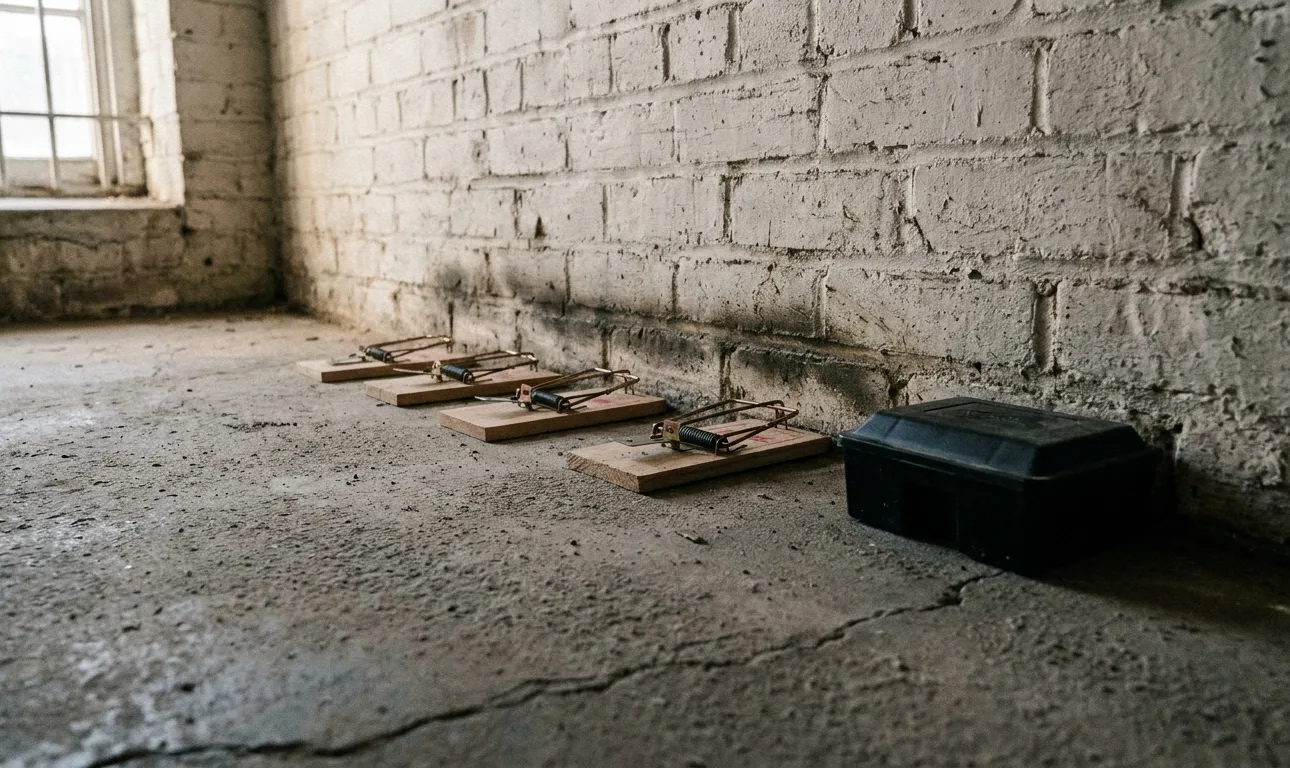
Why we lean on traps indoors
Poison inside an occupied building has a predictable downside: the animal eats it, crawls into a wall or under a floor and dies where nobody can reach it. In a tightly packed row house that odor can travel into the next unit as well as yours.
Traps avoid that. A caught rodent is collected and removed, and you know the count is going down because you can see it. We use snap traps for most work, enclosed so that children and pets cannot reach the trigger, and placed where the evidence says the animals are travelling.
Placement is the whole game
Rodents run along edges. A trap in the middle of a floor gets ignored; one set flush to the baseboard on a known run, with the trigger facing the wall, gets results. In practice that means behind the refrigerator, along the cellar wall, inside the cabinet under the sink and near any hole a pipe passes through.
For mice
Many small traps, close together, because mice range only a short distance from the nest. Ten or more in a kitchen and cellar is normal.
For rats
Fewer, larger traps, often left unset for a few nights first. Rats are wary of new objects, and letting them get used to the trap before it is armed catches the cautious ones too.
What helps while traps are out
- Leave the traps where they are, even if one looks out of place. Moving a trap a foot can take it off the run.
- Put food away in sealed containers so the bait has no competition.
- Keep pets out of the cellar or the rooms with traps if you can.
- Tell us if you hear activity in a new part of the building.
The visit schedule
Set
Traps go out on the first visit, after the runs have been identified and you know where each one is.
Check
We come back within a few days, clear catches, reset and move traps that are not seeing activity.
Narrow
As catches drop, we pull back to the spots still showing fresh signs and focus there.
Finish
When there is a full check with no catches and no new droppings, trapping stops and the remaining openings get sealed.
Most homes in town follow that pattern over a couple of weeks. The team at Hoboken Rodent Control keeps a simple log of every catch so you can see the trend rather than guessing at it.
Removal without sealing does not last
Trapping clears the current population. It does nothing about the gap behind the dishwasher or the open cleanout in the cellar, and the next mouse or rat will find those within weeks. That is why we pair trapping with exclusion work rather than selling it on its own.
If you are handling a few mice yourself, our do-it-yourself mouse guide covers the placement we use. Bigger problems in buildings along the low streets near Observer Highway often need more than that; see downtown Hoboken.
Trapping outdoors in shared yards
Rats living in a rear yard are a different case from rodents inside. Open traps outside catch birds and neighborhood cats, so anything we set in a yard goes inside a locked station bolted or weighted in place, with the entrance sized for a rat.
Yard work also depends on cooperation. If three buildings share a fenced space and only one wants treatment, the stations still help, but results come faster when the whole yard is handled at once. We are happy to explain the plan to the other owners.
Trapping questions
Why are there no catches for the first few nights?
With rats that is often deliberate: traps sit unset until the rats accept them. With mice it can mean a trap needs moving closer to the run.
Do you take the dead rodents away?
Yes. Every catch is removed on the check visit and bagged out of the building.
What about glue boards?
We rarely use them. They are slow, they hold the animal alive, and a rat can drag one off. Snap traps are quicker and more humane.
What if I hear one in the wall overnight between visits?
Call us. If activity spikes, we can move the next check up or add traps where the noise is.
How do I know it is finished?
No catches across a full check, no fresh droppings and no new gnawing. That is the point where we close up the last openings.