
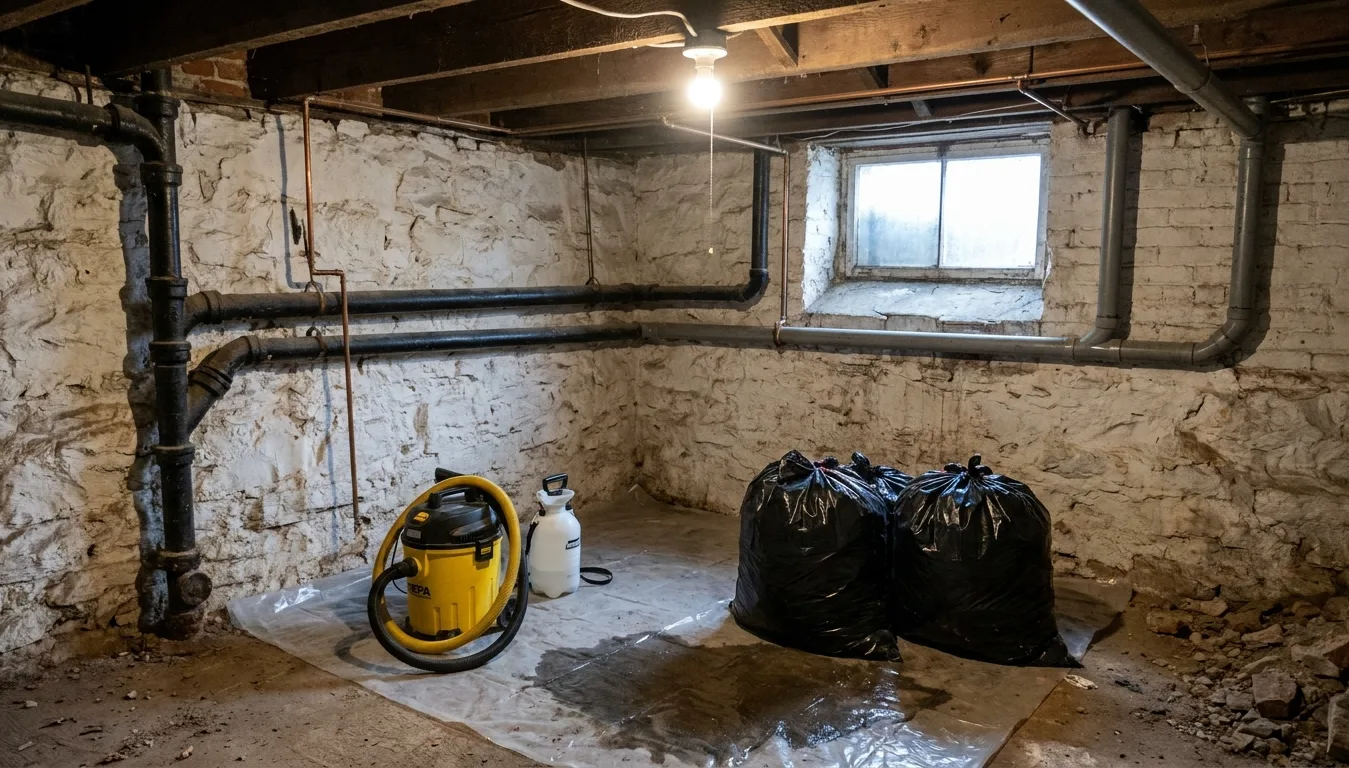
Why cleanup is its own job
Rodent droppings and urine can carry bacteria and viruses, and the public-health advice is consistent: do not sweep or vacuum them dry, because that puts particles in the air. They should be wetted with disinfectant first and then picked up.
There is also the practical side. Rodent urine marks a route by scent, and new arrivals follow it. Leaving soiled material in place makes the space more attractive to the next mouse.
Where the mess usually is in a Hoboken home
- In the cockloft, the low void between the top-floor ceiling and the roof, where nesting sits on top of old loose insulation.
- Under the kitchen sink and behind the toe-kick panels.
- Behind and beneath the stove, dishwasher and refrigerator.
- In the cellar along the foundation walls and on top of the sill.
- Inside dropped ceilings and soffits in renovated units.
- Storage closets with cardboard boxes, linens or old clothing.
How we clean
Confirm activity has stopped
Cleaning while rodents are still living in the space just means doing it twice. We clean after trapping shows they are gone.
Protect and wet down
We wear gloves and respiratory protection, and spray droppings and nesting with disinfectant before touching anything.
Remove and bag
Droppings, nests and soiled material are collected, sealed in bags and taken out of the building.
Disinfect surfaces
Floors, shelves and the insides of cabinets are wiped down, and the areas along runs get a second pass.
Replace what cannot be cleaned
Insulation that is heavily soiled is pulled and replaced rather than sprayed and left.
The attic in a Hoboken row house
Most brownstones and brick walk-ups here have flat or gently pitched roofs, so there is rarely a walk-in attic. What there is instead is a cockloft: a crawl-height void between the top-floor ceiling joists and the roof deck, often continuous across a party wall where the original fire separation was never completed. Mice reach it by climbing the plumbing stack or a chimney chase, and from there they can cross into the neighboring house overhead.
Access is usually a small hatch in a closet ceiling or a roof bulkhead. Inside, we find nests built into the insulation, droppings concentrated along the joists they travel, and stained patches where urine has soaked through to the ceiling below. That staining is often the first thing a top-floor tenant notices.
Food, dishes and kitchen cabinets
Anything in a cabinet that mice could reach should be judged honestly. Food in chewed or open packaging goes in the trash. Sealed cans and jars can be wiped down and kept. Dishes and utensils stored where droppings were found need a wash before use, and shelf liner should come out and be replaced.
We clean the cabinet boxes themselves, including the back corners and the gap behind the drawers where mice like to nest, and we check whether the hole that let them in has been closed.
Small appliances that sat on the counter during the infestation, such as toasters and coffee makers, are worth a look underneath and inside the crumb tray. Mice find those spots quickly.
Why soiled insulation comes out
Spraying deodorizer over nested insulation and closing the hatch is the shortcut, and it does not work. The smell returns on the first warm day, and the scent trail invites the next mouse to the same spot. Heavily soiled sections get bagged and removed through the hatch, the joist bays are disinfected, and the gaps that let the mice in are sealed before new insulation goes down.
Cellar work follows the same rules at the other end of the building, where Norway rats leave far larger droppings along the foundation and sill.
Where cleanup fits in the bigger picture
Cleanup comes last. It follows inspection, trapping and sealing, and it is the step that lets you put your kitchen back together without wondering what is behind the drawers.
Small amounts of droppings in one cabinet are something many people handle themselves, following the wet-first rule. Larger areas, insulation and anything in a ceiling are worth leaving to someone with the right protection.
If you are not sure how big the job is, describe it to Hoboken Rodent Control on the phone and we will tell you honestly whether it is a do-it-yourself afternoon or something for us.
Cleanup questions
Can I vacuum up mouse droppings?
Not dry. Wet them with disinfectant first, wait a few minutes, then pick them up with paper towels while wearing gloves.
Does the smell go away after cleanup?
In most cases, yes, once soiled material is removed and surfaces are disinfected. A lingering smell can point to nesting that has not been found yet.
Do you replace drywall?
We open small access points when needed to reach nesting. Larger repairs are a job for a contractor, and we will tell you if you need one.
Is cleanup necessary if I only saw a few droppings?
A small amount in one spot can be handled carefully by you. Widespread droppings or nesting in insulation are worth a professional clean.