
What we look at
An inspection here covers more ground than people expect, because the building tells the story rather than the room where the noise was. We start at the lowest level and work up.
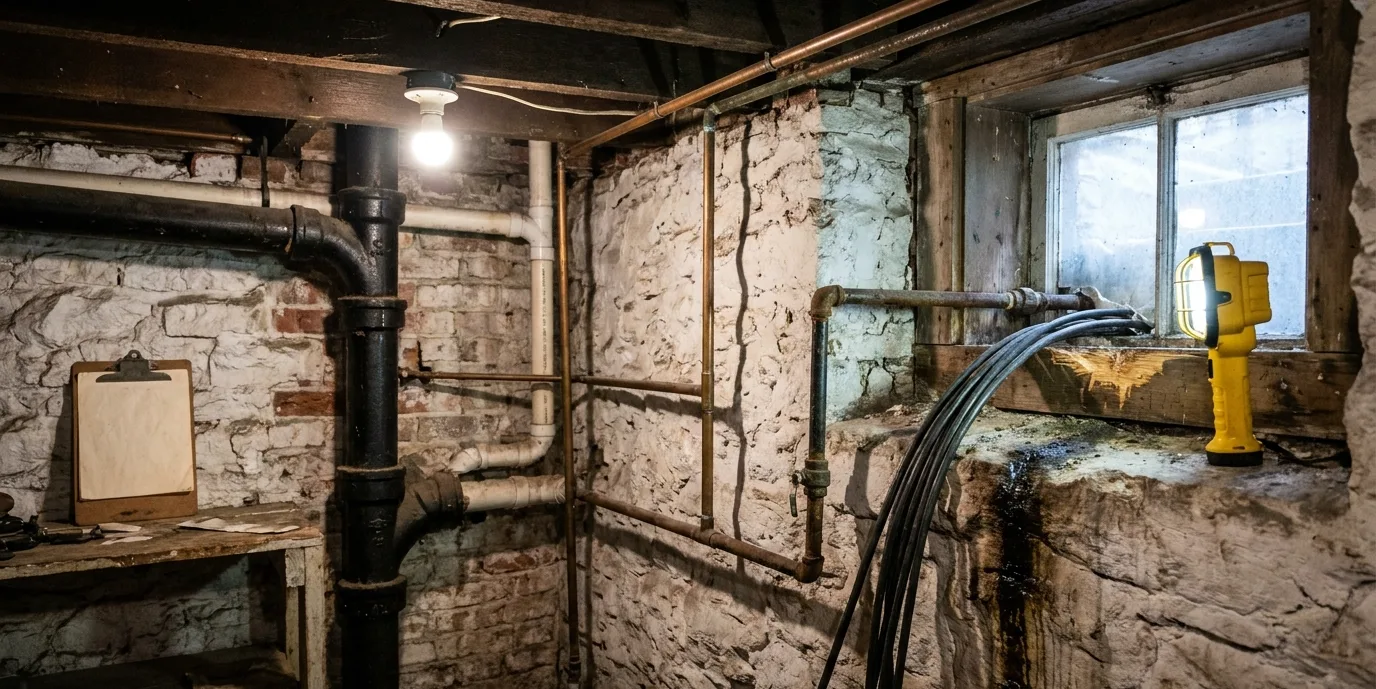
- Cellar and crawl space: foundation cracks, sewer cleanouts, gaps around the water and gas service lines, old coal chute openings.
- Garden-level and first floor: door sweeps, the space under the stoop, vents, dryer exhausts.
- Kitchens and baths on every floor: under sinks, behind appliances, toe-kicks, pipe and riser penetrations.
- Roofline and top floor: loose flashing, gaps at the cornice, unscreened vents.
- Outside: the rear yard, trash storage, burrows along the foundation, and anything that offers food or cover.
What you get at the end
You will know whether you are dealing with Norway rats, house mice or both, which matters because the treatment is different. You will see where the activity is concentrated and which openings are being used.
We put that into a written list of entry points and a recommended plan, so you or your building manager can make a decision without having to take anything on trust. If the plan involves common areas, the list is something you can forward to an association board.
When an inspection on its own makes sense
- You are buying or renting a garden-level apartment and want to know what you are walking into.
- A previous treatment did not hold and you want to know why.
- You manage a building and need a baseline before signing up for ongoing service.
- You found droppings once, nothing since, and want reassurance before forgetting about it.
Reading what the rodents leave behind
Droppings tell us species and freshness: soft and dark means recent, dry and grey means old. Gnaw marks show whether teeth are working on a pipe opening or a food package. Rub marks along a baseboard show a route that has been used for a long time, because the grease builds up slowly.
We also look for what is not there. A cellar with old droppings but nothing fresh may have had a problem that ended. A kitchen with fresh signs and no obvious entry usually means the way in is somewhere less visible, like a riser chase or a gap behind built-in cabinetry.
What we ask before we arrive
When you call, we will ask what you have seen or heard, when, and on which floor. We will ask whether the building has a cellar, a rear yard and shared trash storage, and whether there has been any work done recently. Those answers shape where we start and how long to set aside, and they often point to the answer before we even get there.
Older buildings need patience
Row houses in this city have been altered many times over more than a century. A wall that looks solid can hide an abandoned chimney flue, a boxed-in pipe run or a gap where two renovations never quite met. Those are exactly the spaces rodents use, and finding them takes a flashlight, a mirror and time rather than a quick walk-through.
That is also why the inspection is the part of the job we are least willing to rush. If cost is on your mind, our page on what rodent control costs in Hoboken explains which findings make a job bigger or smaller.
Once the inspection is done, the next steps are usually trapping and sealing. Whatever you decide, the findings are yours to keep, and Hoboken Rodent Control will walk you through them in plain language before anyone touches a tool.
Inspection questions
How long does an inspection take?
A single apartment is usually under an hour. A whole row house with a cellar and yard takes longer, depending on access.
Do I need to be home?
Someone needs to let us into each space we are inspecting, including the cellar and any locked common areas.
Can you tell how long the rodents have been there?
Roughly. The amount and age of droppings, nesting material and rub marks give a fair sense of whether it is new or long-standing.
Should I clean up droppings before you arrive?
Please leave them. They are evidence, and they help us tell what you have and where it is most active.
Will you inspect the neighboring building?
Only with that owner's permission. We will note where activity seems to be coming through a shared wall.