
How mice move through a Hoboken building
A house mouse can squeeze through a gap about the width of a pencil and climbs rough brick with ease. In a 19th-century walk-up that gives it a whole network of highways: the cavity behind plaster on a party wall, the chase where the plumbing stack rises floor to floor, the oversized holes around old radiator pipes and the gap under a kitchen's toe-kick.
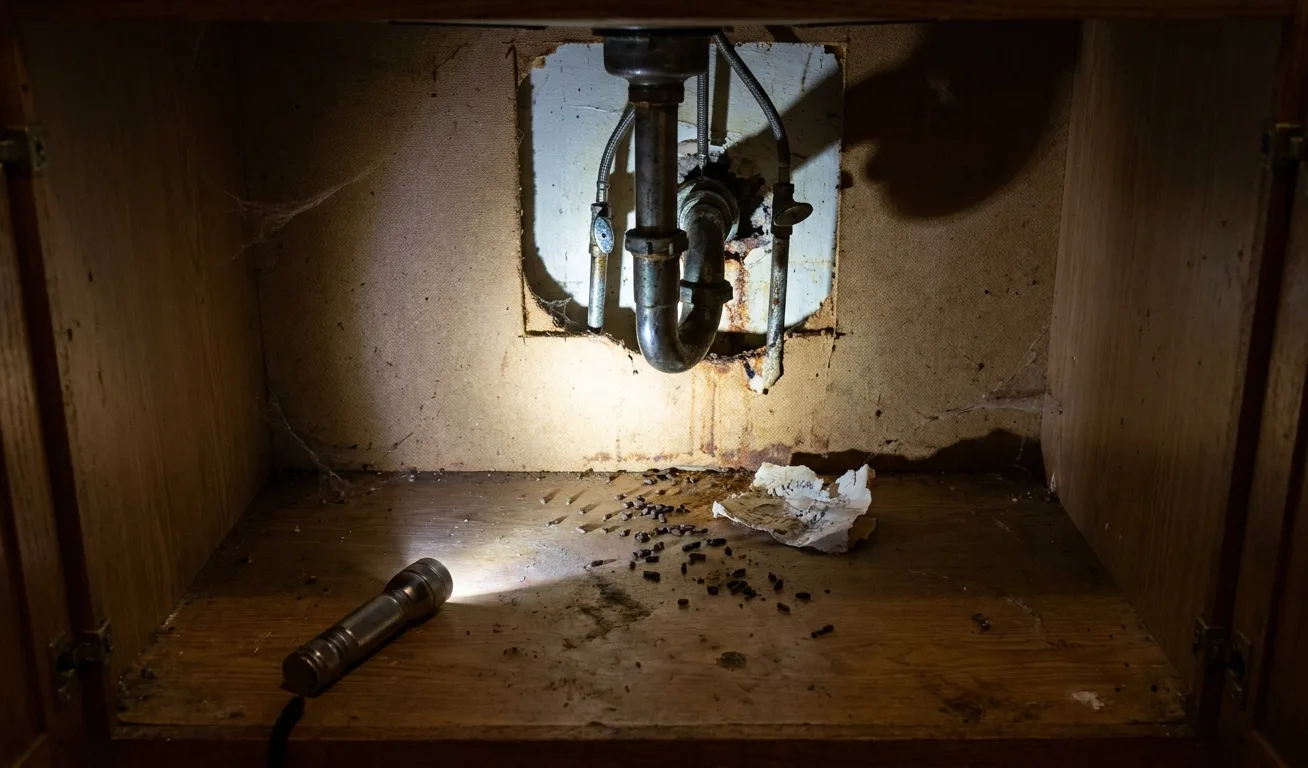
Most of the calls we take at Hoboken Rodent Control start in a kitchen, because that is where food and the plumbing meet. The mice are rarely living in the kitchen itself. They are nesting in the warm, undisturbed space nearby and commuting in after dark.
What tells you it is mice
- Droppings like dark grains of rice, pointed at both ends, in drawers, behind the stove or under the sink.
- Light, quick scratching inside a wall or ceiling, usually in the evening and the hours before dawn.
- Shredded paper towel, insulation or fabric tucked into a hidden corner.
- Small chew holes in cereal boxes, pet food bags or bread wrappers.
- A faint, stale ammonia smell in a closed cabinet.
Our approach to a mouse problem
Find the entry, not just the mouse
We pull the kick plates, look under the sink and behind the range, and check where every pipe and cable passes through a wall or floor. Each opening is noted, because every one of them will need closing.
Trap, do not scatter
Snap traps placed tight against the walls along active runs do most of the work. We avoid loose poison inside living space; a mouse that eats it can die in a wall cavity and leave you with the smell for weeks.
Seal unit by unit
Steel wool on its own rusts and gets pushed out. We pack gaps with copper or stainless mesh, then finish with sealant or patch. Larger penetrations get a metal plate. The detail is on our exclusion and sealing page.
Why the neighbors matter
If you seal your own unit and the building next door still has mice, you have protected your space, which is worth doing. But the pressure stays on the shared walls. When we can, we suggest the owner or association look at the cellar and common hallways too, since that is where mice usually enter before spreading up.
Newer construction along the waterfront and in the northwest is not immune either. Mice there tend to come in through garage levels, trash rooms and utility penetrations rather than through old brick. Our northwest Hoboken page covers those buildings.
Kitchens, closets and the space behind the stove
Mice are not choosy eaters, but they are creatures of habit. Once one finds a reliable source — a dog bowl left down overnight, a bag of rice on a low shelf, crumbs that slide under the range — it will return to it nightly and others will follow the same path.
Moving dry goods into glass or hard plastic containers, lifting pet food at night and pulling the stove out to clean behind it makes trapping work faster, because the traps become the most interesting thing on the route. We will point out the specific spots in your kitchen while we are there rather than handing you a generic list.
Doing some of it yourself
Plenty of people start with their own traps, and that is reasonable. If you want to try first, our guide on how to get rid of mice in Hoboken goes through placement and the common mistakes. Call us when the catches keep coming after two weeks, because that usually means an open entry point is refilling the space.
Questions about mice in Hoboken apartments
Why do I see more mice in the fall?
Cooler nights push mice indoors toward warmth, and heating systems starting up make wall cavities more comfortable. Activity often climbs from October onward.
Is one mouse really a problem?
Seeing one usually means there are more out of sight. Mice breed quickly, so it is easier to deal with early.
Do ultrasonic plug-in repellers work?
We have not found them to be a reliable fix. Mice get used to the noise and the gaps they use are still open.
Are mice in a new building a sign it was built badly?
Not necessarily. New buildings have plenty of utility openings, and mice arrive with deliveries, furniture and through garages. It is usually fixable with targeted sealing.
Can you work around a newborn or pets?
Yes. Indoors we use enclosed traps placed out of reach and tell you exactly where each one is.