
The openings that matter here
Old brick buildings are full of holes nobody thinks about. A plumber cuts a generous opening for a new drain line and never patches around it. A cable installer drills through the cellar wall. Mortar joints at grade crumble after a century of freeze and thaw. Each of those is an invitation, and Hoboken Rodent Control spends most of an exclusion visit finding and closing them one at a time.
- Gaps around water, gas, sewer and electrical lines where they enter the cellar.
- Pipe and riser penetrations between floors, especially under kitchen and bathroom sinks.
- Crumbling mortar and cracks at the base of foundation walls.
- Cleanout caps that are cracked, loose or missing.
- Gaps under exterior doors, garden-level entries and cellar hatches.
- Unscreened vents, dryer exhausts and old through-wall air conditioner sleeves.
Materials we use and why
Rodents gnaw through expanding foam, caulk, wood and thin plastic. Anything we seal with needs to stop teeth first and look tidy second.
Mesh and sealant
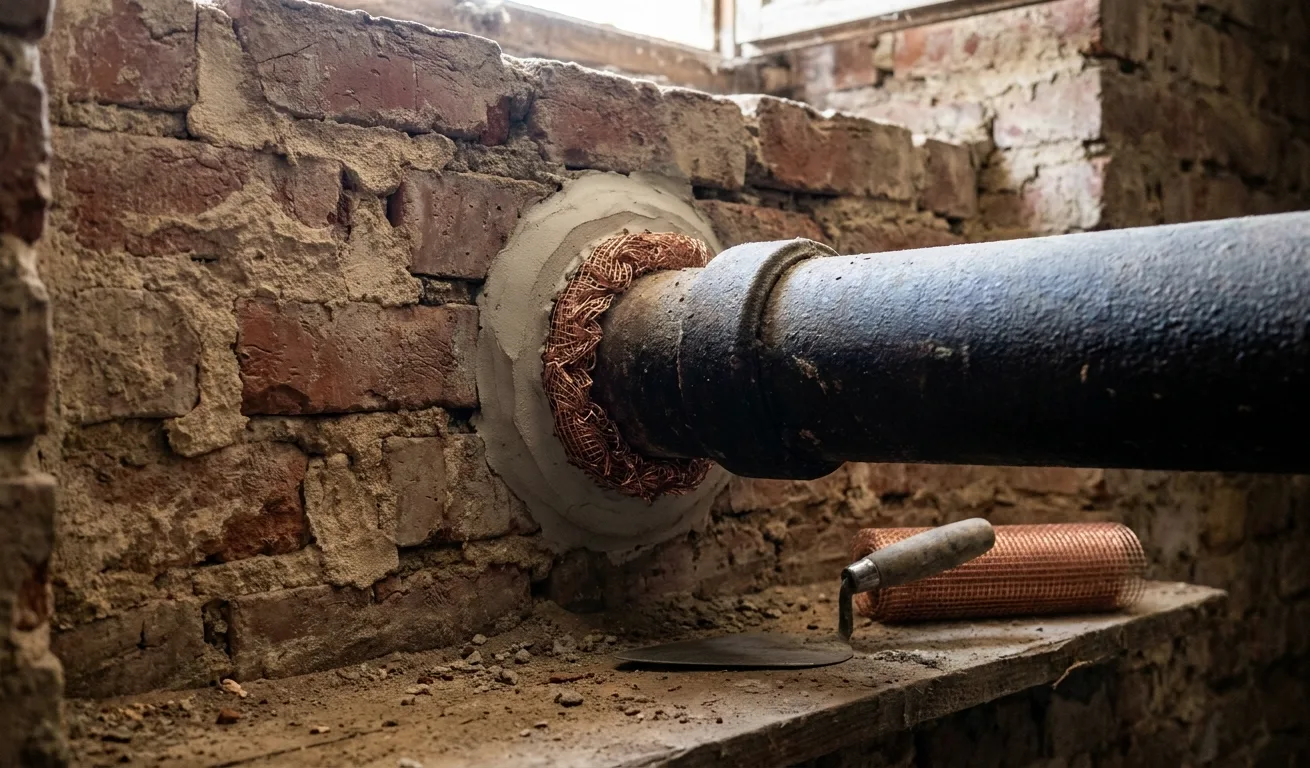
Small gaps around pipes are packed tight with copper or stainless mesh, which does not rust out the way plain steel wool does, then finished with sealant to hold it in place.
Metal plates and collars
Larger penetrations get a fitted sheet-metal plate or a pipe collar fastened to the surrounding surface.
Mortar and patching
Foundation gaps and broken joints are repointed or patched, since masonry is the one surface a rat cannot get a grip on.
Door sweeps and thresholds
A gap a quarter-inch tall under a door is enough for a mouse. Heavy-duty sweeps with a metal backing close it.
Timing: seal after the trapping, not before
Closing up a building with rodents still inside traps them in. They will chew their way out, sometimes through a wall you just painted. We seal in stages: the openings we can safely close right away, then the rest once trapping shows the population is gone.
What exclusion cannot fix on its own
Sealing your building does not change what is happening next door or in the street. A rat colony living under a neighbor's yard will keep testing your foundation. Exclusion makes that testing fail, which is the point, but it helps to know the pressure is still there.
In the flood-prone blocks of the southwest, heavy rain can also push rats up and out of the sewers and into the nearest open cellar. Sealing cleanouts and service-line gaps there is especially worthwhile; our southwest Hoboken page goes into that.
Garden-level apartments
The unit at the bottom of a row house sits closest to the yard, the cellar and the sewer, so it takes the most pressure. Its front door is often below the stoop, its kitchen backs onto the yard and its utility lines come straight through the foundation wall. Those homes benefit most from a thorough seal, and they are where we usually find the largest openings.
After any work on the building
New plumbing, a replaced boiler, cable upgrades or a kitchen renovation all create fresh holes. Contractors close them for looks, not for rodents. If you have had work done, a quick check of the new penetrations afterwards is worth the time.
The same goes for seasonal changes. Window air conditioners pulled out in autumn leave an open sleeve or a loose panel, and a door that swells and shrinks with humidity can open a gap at the bottom that was not there in July.
Rodent-proofing questions
Is steel wool enough?
Not by itself. It rusts in damp cellars and rodents can pull it out. We use copper or stainless mesh with sealant over it.
Do I need the landlord's permission?
For anything that alters the building, such as patching a foundation or a shared wall, yes. Sealing inside your own cabinets usually is not an issue, but check your lease.
Will sealing change how my apartment looks?
Most work is in cellars, under sinks and behind appliances. Anything visible gets finished neatly or painted to match.
Can you seal the outside of a brick building?
Yes, at ground level and along the foundation. Work at height on a facade is for a masonry contractor, and we will say so if it is needed.
How long does exclusion last?
Metal and masonry hold for years. New openings appear when work is done on the building, so it is worth a check after any renovation.